


Home / Academics / Departments / Nursing Department
Nursing Department
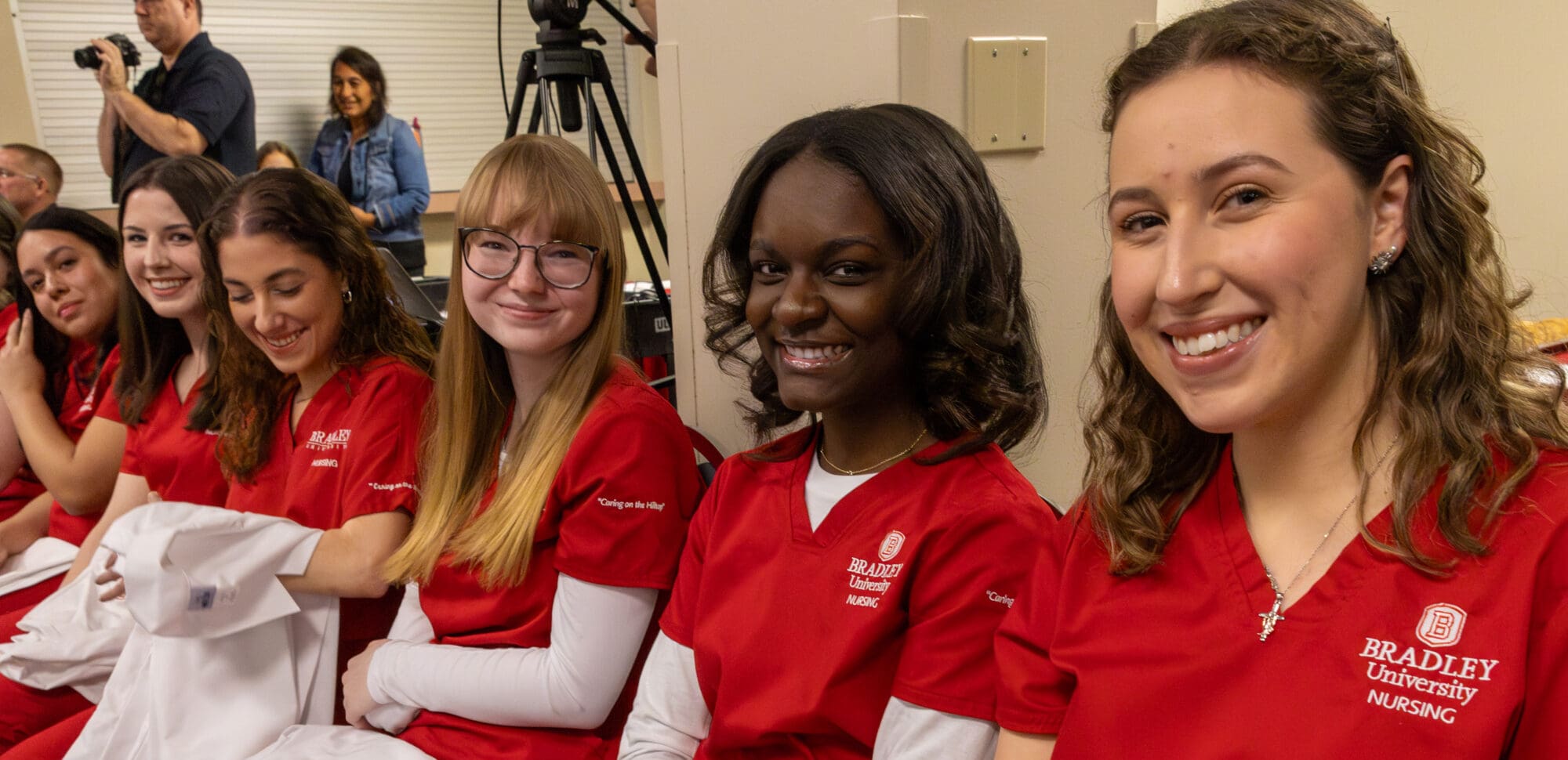
At Bradley, you’ll build confidence as a caregiver and health advocate through challenging coursework and diverse clinical experiences gaining the skills and hands-on practice needed to succeed in the field.
Peoria’s thriving medical community—with two major hospital systems, public health facilities, and nursing homes—provides an incredible variety of clinical experiences, ensuring you explore different medical settings and career paths.
Guided by expert faculty and clinical supervisors, you’ll receive personalized mentorship from professionals who are passionate about teaching and supporting students both on campus and online. By graduation, you’ll have a strong network of connections to launch your career with confidence.
Majors
Nursing
Become an experienced healthcare professional through the entry program to earn a BSN.
Learn More
Accelerated Nursing (ABSN 2nd Degree)
A streamlined program for nursing students who already have a bachelor’s degree and meet program prerequisites.
Learn More
Online Programs
Nursing MSN, DNP, & Certificate Programs
Build your healthcare skills towards a future as an advanced practice nurse in areas such as Adult-Gerontology Acute or Primary Care, Family Practice, Psychiatric Mental Health, or Nursing Leadership across other specialized areas.
Learn More
Department Resources
BSN Program
The graduate will…
- Integrate nursing knowledge along with foundational liberal arts, natural, and social sciences to form clinical judgment for application within baccalaureate nursing practice.
- Apply the principles of person-centered care to guide nursing practice in all spheres of care.
- Utilize population health principles to collaborate with multiple stakeholders to provide diverse, equitable, and inclusive care.
- Evaluate and summarize current evidence to improve and transform the delivery of nursing care.
- Integrate a culture of quality and safety to improve outcomes and minimize risk.
- Collaborate with interprofessional team members, patients, families, and communities to optimize care.
- Apply knowledge of systems and evidence-based practice to coordinate resources to provide safe, quality, and ethical care to diverse populations in an ever-changing healthcare environment.
- Integrate patient-focused and health information technologies and processes to manage care in accordance with best practice and professional regulatory standards.
- Develop a nursing identity that upholds professional standards of legal, moral, ethical, and collaborative practice.
- Demonstrate behaviors and attributes that reflect accountability in personal, professional, and leadership skills.
MSN Program
The graduate will…
- Demonstrate innovative nursing knowledge along with arts, humanities, and other sciences within advanced nursing practice.
- Integrate principles of person-centered care in advanced nursing practice in all spheres of care.
- Integrate policies into practice that support diverse, equitable, and inclusive care for the improvement of population health outcomes.
- Integrate best evidence to enhance nursing practice.
- Apply quality improvement principles to promote a culture of safety and clinical excellence.
- Facilitate opportunities for collaboration between interprofessional team members, patients and communities to optimize care.
- Evaluate evidence-based methodologies within complex systems of healthcare to provide safe, quality, and ethical care to diverse populations.
- Utilize health information and communication technologies to improve the management of care in accordance with best practice.
- Uphold nursing identity that exemplifies professional standards of legal, moral, ethical, and collaborative practice.
- Demonstrate leadership traits that exemplify personal and professional accountability for health and well-being.
DNP Program
The graduate will…
- Synthesize arts, humanities, and other sciences along with nursing knowledge to innovate clinical judgment within advanced nursing practice.
- Analyze the principles of person-centered care in advanced nursing practice in all spheres of care.
- Coordinate with multiple stakeholders to engage in policy development that promotes diverse, equitable, and inclusive care for the improvement of population health outcomes.
- Advance the scholarship of nursing through the creation and dissemination of evidence-based practice.
- Lead quality improvement initiatives that enhance and promote a culture of safety and clinical excellence.
- Foster opportunities for collaboration between interprofessional team members, patients and communities to implement solutions to optimize care.
- Design and recommend evidence-based methodologies within complex systems of healthcare to provide safe, quality, and ethical care to diverse populations.
- Evaluate system-based approaches and recommend health information technologies to manage care that is equitable and inclusive.
- Demonstrate consistent application of nursing identity that upholds professional standards of legal, moral, ethical, and collaborative practice.
- Lead others while upholding accountability for personal and professional skills, and attributes.
Mission
The mission of the Department of Nursing is to prepare baccalaureate and advanced practice nurses. Through faculty and student collaboration, dynamic learning environments, and mentoring, nursing graduates are prepared to be the next generation of nursing leaders and lifelong learners that will meet a global society’s health care needs.
Vision
The Department of Nursing is committed to excellence in the preparation of professional nurses for a changing global society. Within the comprehensive university setting, the Department of Nursing provides a dynamic personalized nursing education.
Core Values
- Excellence: Students are provided with distinctive educational programs and a supportive environment to fulfill their intellectual, aesthetic, and professional needs.
- Leadership: Students are prepared to utilize evidence based practice to manage patient care, promote quality improvement, and to lead interprofessional teams.
- Innovation: Students are prepared to integrate knowledge, skills and attitudes to improve patient outcomes and foster a culture of safety.
- Globalization: A liberal education provides a foundation for lifelong learning and prepares professional nurses to practice in a global society.
- Collaboration: Students are prepared to participate as members of the inter-professional team to deliver patient centered care.
- Community: Students are prepared to use evidence based practice in implementation of the nursing process to assist individuals, families, groups, communities, and populations across the lifespan in achieving optimal health.
The Bradley University Department of Nursing values input from students! In order to encourage student feedback on a variety of topics and issues, we have created an Opportunity for Improvement Form. This form will allow you to voice informal comments, questions, complaints or compliments related directly to your experiences within all nursing programs. This form does not replace student course evaluations completed at the end of each academic term. This form can be submitted anonymously or you may provide your contact information for follow up from the Associate Dean of Nursing.
The Baccalaureate degree program in nursing, the Master’s degree program in nursing, the Doctor of Nursing Practice program, and post-graduate APRN certificate program at Bradley University are accredited by the Commission on Collegiate Nursing Education, 655 K Street NW, Suite 750, Washington, DC 20001, (202) 887-6791.
Nursing Department Policies
- Department of Nursing Technology Requirements
- Dress Code for Practicum
- Graduate Clinical Requirements Policy
- Graduate Course Extension/Incomplete Grade Request Procedures
- Graduate Nursing Academic Progression, Withdrawal, and Dismissal
- Graduate Professional Behaviors Policy
- Health Insurance Portability and Accountability Act of 1996 (HIPAA) Compliance
- Health and Hospitalization Insurance Policy
- Non-Acceptance of Undergraduate Nursing Coursework Outside of Bradley University
- Petition to Re-enter the Nursing Coursework Sequence – Undergraduate
- Practicum Attendance Policy – Undergraduate
- Professional Behaviors Policy
- Reserved Sections of Nursing Courses – Undergraduate
- Skills Lab Bag Contents & Lab Equipment Usage Policy – Undergraduate
- Special Clinical Placement Requests – Undergraduate
- Student Grievance Policy – Undergraduate
- Undergraduate Admission and Transfer Policy
- Undergraduate Integrated Testing Policy
- Undergraduate Testing Policy – Student
- Undergraduate Nursing Academic Progression, Withdrawal, and Dismissal
- Undergraduate Nursing Practicum Requirements
- Undergraduate Practicum Remediation Process
- Undergraduate Registration Eligibility for Nursing Internships
- Use of Social Media Policy
- Use of Technology in the Practicum Setting
Faculty & Staff
- Adrienne Nelson
- Alex Copeland
- Allison McKenzie
- Amy Grugan
- Ashley Hammond
- Belinda Daly
- Bridget Welker
- Deborah “Deb” Erickson
- Debra Wise
- Gary Tupper
- Jada Warmick
- Jo Muller
- Karin Smith
- Kelley Obringer
- Kelly Fogelmark
- Kirsten Boyer
- Laura James
- Lisa Friebohle
- Mai Singh
- Rachel Borton
- Rachel Bridgewater
- Renee Pierce
- Sarah Clark
- Shanna Krause
- Shelby Hinspeter
- Sokonie Reed
- Summer Hinthorne
- Tori Hoyle
- Valerie Ragon